Up-dated 16th February 2022. Please advise me in the comments if amendment is needed.
Air travel
Travel by air has become a bit more complicated since 9/11 and covid. I was travelling through the USA on my first rtw trip in March 2003 when the Iraq war started. Security went nuts and within a week we missed a flight from St Louis to Atlanta because we spent two hours in security. TSA took a long time to find a way to secure air travel without grossly inconveniencing passengers. However, after the initial over-reaction things have settled a bit now.
COVID
The rules for COVID vary for different countries and airlines. Always check those before you pay for a ticket and be wary of airline refund policies. Check vaccination rules and what tests (PCR, RAT etc) are required and their timing, check whether self-isolation or quarantine will be required on arrival and whether that will affect your access to needed medical supplies, food or drinks.
Food
Hypo protection
For the possibility of lows, I just carry jelly beans. Simple and not bulky, which is important these days for carry-ons with many airlines strictly enforcing size limits.
Mid Air Snacks.
Making some snacks up in advance is best because you can choose exactly what they are. You aren't restricted to the over-priced limited range available at the airport. I usually make up a small sealed plastic container of mixed nuts and raisins. It keeps well, can be kept in a pocket or purse for a quick nibble to stave off hunger and gives a good mix of protein, fats and carb. If that is not possible, I seek out something suitable in the air-side shops. Things like beef jerky (check the carb count), nuts, cheese-'n-crackers or similar. Not for meals, but for those times when you need something to nibble on during a long flight. I don't try for very low carb, but a mix of carbs, protein and fat, including about 5-10 gms carb in a snack.
I never go on a flight without sufficient for two or three snacks in my carry-on. It may be scheduled as a one-hour hop. But, after the first time you've waited three hours in the gate lounge and then sat in a delayed plane on the taxi-way for several hours without food, air-conditioning or information you realise that travelling in those conditions without snacks is not wise. It may only ever happen to you once, but that will be too often if you don't have food available every few hours.
In-flight Meals.
This is becoming a hypothetical subject, but there are still a diminishing number of Airlines that provide meals in cattle class.
Never, ever, ring in advance to advise that you have diabetes and wish to have a "diabetic" meal. If you do, be ready to eat a meal that will commence with a bread roll, followed by a main of low-fat starch, with sides of starch, washed down with fruit juice, followed by a piece of fruit and a dessert of low-sugar rice pudding or similar.
Instead, I have a standard procedure. I wait until the initial boarding rush is over and I can catch the attention of the steward. I advise the steward that I have diabetes that I manage with a strict diet. Then I patiently nod and smile through the set "you should have advised us in advance so we could have provided a special diabetic meal for you". I apologise for not doing so and request a look at the menu of the day. I then choose the least bad choice. Failure to do this means you are risking no choice at all when they run out of the beef casserole and you find that pasta and rice is the only choice left. On two notable occasions, when there were no remotely acceptable choices, the senior steward suggested that I might prefer something from the business class menu. You get a different class of service on Qantas and Air New Zealand.
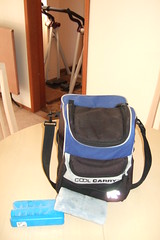
For longer flights I carry a cooler pack with me. This thing wandered around the world twice with me:
It doubles as my carry-on for medications and other things I need to get at quickly. Most airlines will allow something like that as a second carry-on, but check if your airline has a one-bag limit.
I often prepare a salad the night before, usually with some cold cuts or similar, and pack it in an appropriate small plastic lunch container. The dry food will get through the TSA security, but liquids won't; I haven't tried a freezer brick through security since those rules changed, so I would transfer the food from the fridge to the pack as late as possible. After passing through security buy a cold drink which can also act as a cooler for the insulated section. If you don't want to pre-prepare you can nearly always buy a prepared salad, or jerky or something similar on the "air" side of security.
Don't try to get drinks through airport security - they will probably be
confiscated. Buy your cans or bottles after the security check if you need them; I usually have a coffee instead. On board, I have never travelled on an airline that did not provide water or diet soda on demand, sometimes free.
Medications and Diabetes Supplies
When I fly I always carry a letter from my doc listing my ailments and medications. I have only rarely needed that letter, but on those rare occasions it saved me a lot of stress and hassle. For diabetes supplies read the current rules on the TSA web-site - they apply to all US airports and many overseas airports also use them as a general guide.
heck
or Carry-on
We know that traveling with medical supplies can be a nerve-wracking experience, especially when your medication includes needles and other sensitive equipment. So here are some tips to help make your trip as smooth as possible.
Notify the Officers
When you arrive at the checkpoint, let our officers know about your medical device and any other equipment prior to screening. If you have an insulin pump, glucose monitor or other medical device attached to your body, inform the officers where it is located before the screening process begins. Although not required, you can provide them with a TSA notification card prior to screening to discreetly describe the medical condition.
If you have questions or concerns at any time during the screening process, please ask to speak to a supervisor.
Screening Process
Passengers in standard lanes may be screened by advanced imaging technology, metal detector or a pat-down. If the standard lane does not have advanced imaging technology, or if you are eligible for expedited screening through TSA PreCheck®, you may be screened by a walk-through metal detector. If you do not wish to go through screening by technology, inform the TSA officer and they will conduct a pat-down. Pat-downs are conducted by a TSA officer of the same gender, and you may request private screening at any time.
You will not be required to remove any medical devices attached to your body.
If you are traveling with medical equipment or supplies, they will need to undergo separate screening. The TSA officer will check the supplies and conduct any necessary testing. If your medical condition requires it, you are allowed to travel with a juice box or other liquid over 3.4oz., but be prepared for the liquid to receive additional screening.
In the event that your insulin pump or glucose monitor is attached to your body, the device is subject to additional screening, including visual inspection. You may be required to conduct a self pat-down of the actual device, followed by a test of your hands for any trace of explosives.
Still have questions? Visit our website for additional information.
TSA Cares
If you have any additional questions or need assistance at the checkpoint, reach out to TSA Cares at 855-787-2227. Simply call 72 hours prior to your trip or visit our TSA Cares website. Knowing more about the process may help to relieve any stress and anxiety!
Road Trips
When possible I prepare exactly the same snacks as I do for an air trip and carry the cooler pack on board. That gets a lot of use in the car, because there will always be a bottle or two of diet soft drinks, a bottle of wine and some cheese, crackers or similar. I add a couple of freezer bricks to keep things cold and fresh. Each night I put those in the room fridge, if it has one, or ask the hotel staff to keep them in the restaurant freezer. I've never had that request rejected but I have occasionally forgotten to collect them in the morning. No big deal, they only cost a couple of bucks. I also store small containers of olive oil for salad dressing or cooking oil, vinegar, salt and pepper in the side pockets.
If the accommodation I am using has cooking facilities I always prefer to cook my own simple breakfasts. While on the road it is easy to pick up some eggs, maybe an onion, mushrooms, cheese (or whatever you like) to make a simple omelette or scrambled eggs in the morning.
I look for diners and Mom and Pop restaurants when I'm on the road. The sort of place where I can get bacon and eggs for breakfast, or they will listen when I ask them to hold the fries and double the salad.
Breakfasts
Hotel breakfasts can vary from wonderful buffet choices to disastrous "continental" breakfasts of a tired croissant and grey cold imitation coffee. They can also be incredibly expensive, with minimum prices in the restaurant or high extras and tips on room service. I refuse to pay $20+ for some watery scrambled eggs and a coffee. If the hotel choice is OK or I can cook my own, wonderful. If not I have a standard routine on arrival at a hotel.
I ask at reception where the nearest diners, cafes and restaurants are and for recommendations. At an appropriate time after I check in, usually after dinner, I take a walk around the district. If I arrived by car I will have already been watching for restaurants as I drove in. I use the walk for exercise and also to check out an appropriate place for breakfast. It is rare that there are no diners or similar within a reasonable walk - which also doubles as my morning exercise.
Eating Out
When I am travelling with my wife, eating out is much simpler. On two trips around the world with her we left a reputation behind us as Aussie cheapskates because, wherever we went, we would order one main course and a spare plate for the two of us. It took some cheek, but we didn’t put the weight back on. We also saved some cash, but that was a bonus, not the intention. Where it wasn’t possible because of language or embarrassment of others, we would order a main course and a side salad or starter – just to get the plate – then mix between the two. This allowed me to leave the high carb items for my non-diabetic wife.
We often found that we still left food on the plate, even when we shared. The food is actually the smallest cost in running most restaurants; many chefs provide enormous serves to attract customers.
When I travelled alone, it was more difficult. I, like many, was raised in an environment where waste was frowned upon - waste not, want not. As a post-WWII child I was taught to clean my plate before leaving the table.
It takes discipline to break the habits of a lifetime and leave over half the food on the plate when you know you are paying for it. But if you eat it, you will pay much more eventually. Specify that you absolutely, definitely do NOT want chips/fries. Many restaurants add them automatically.
For dinners, when travelling alone, I found the method I used most often was to order an appetiser and a side salad instead of a main course. If that was too small I would order a second appetiser. That led to some marvellous and delicious meals; often the appetisers are more varied than the main course and aren't accompanied by piles of potato, rice or fries.
My most common lunch when travelling is "Soup of The Day". But be a little careful of thick "cream" soups; they will often be thickened with cornstarch, flour or potato. In 2006 I happened to be wandering through Germany in Spargelsuppe season. Bliss.
I'm sure I'll recall other tips after I post this, so I'll probably return regularly and up-date it.
Bon Voyage
Cheers, Alan
Everything in Moderation - Except Laughter.